
How the Earth was measured · part 1 of 2. You cannot put the Earth on a weighing scale. But you can notice how it and other bodies attract the same load. The first convincing numerical estimate of the average density of the Earth came from observations at a Scottish mountain in 1774 and a calculation published four years later. Knowing the size of the planet, its mass can be deduced from its density.
Who, where and when
In 1774, English astronomer Nevil Maskelyne was working at Mount Schiehallion in Scotland. The experiment was supported by the Royal Society of London. The mountain was suitable due to its relatively simple shape and the fact that there were no equally large peaks nearby: its own attraction was easier to separate from other influences. Later, mathematician Charles Hutton processed geodetic measurements of the mountain and published the calculation in 1778. This is how an early experimental estimate of density arose - and therefore, with a known volume, the mass of the Earth.
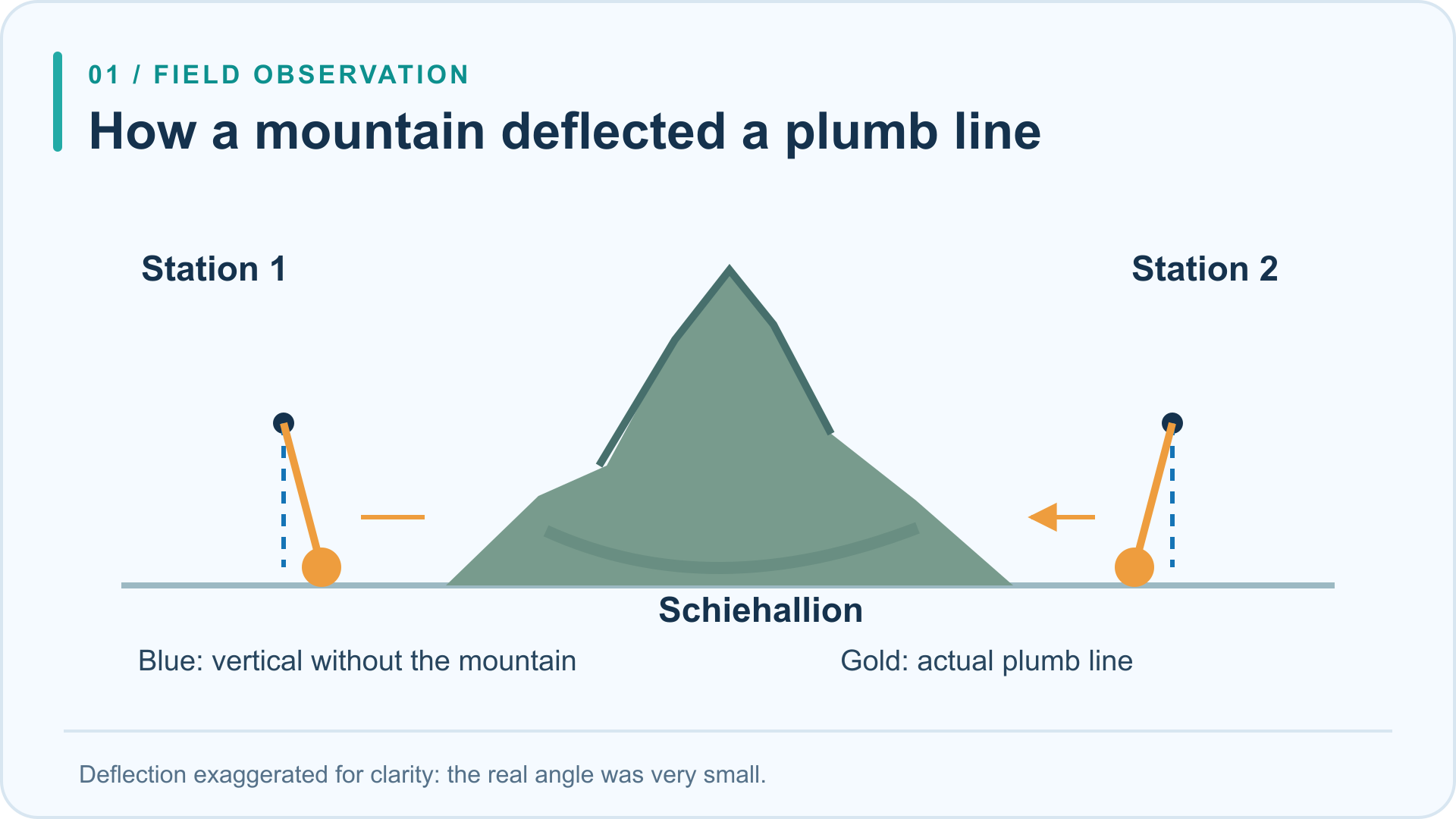
Scheme: on both sides of the mountain the plumbs deviate slightly towards its top; the dotted line shows the direction without the attraction of the mountain
Scheme 1. The angle is deliberately increased so that it can be seen. Open larger →
What astronomers saw
A suspended load usually shows the direction of the local vertical. But Schiehallion exerted a small sideways pull on it. Maskelyne observed the stars from different sides of the mountain and compared their positions relative to the plumb line. The difference between observations revealed a tiny deviation that could not be noticed simply by eye.
The force of gravity pulls the load down, and the mountain adds a weak lateral component. Therefore, the plumb line tilts towards the mountain. The greater the mass of the mountain relative to the mass of the Earth, the more noticeable the tilt. But in order to turn the angle into a number, it was necessary to find out the volume of the mountain and estimate the density of its constituent rocks.
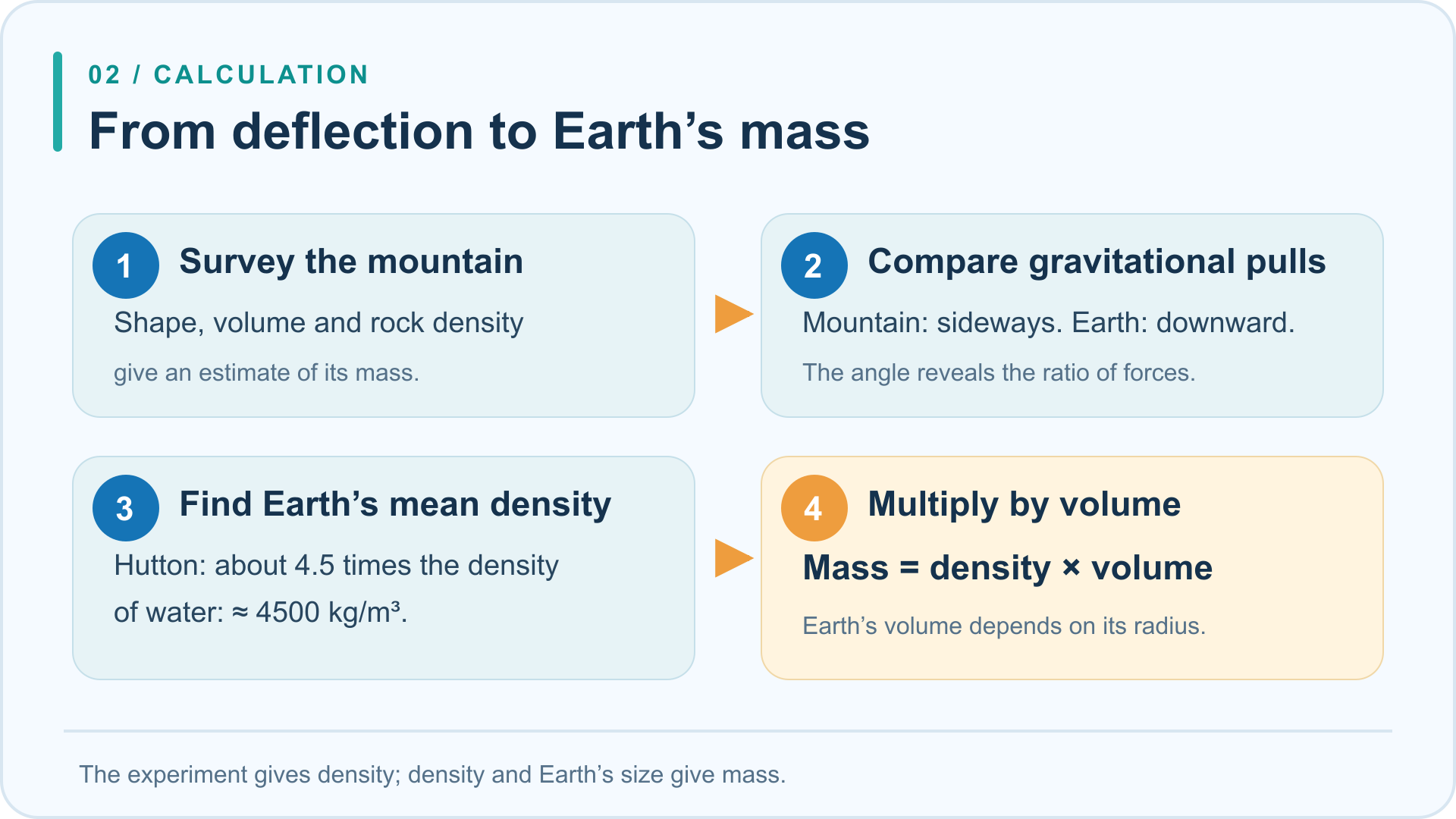
Four steps diagram: measure the mountain, compare the forces of gravity, find the average density of the Earth, multiply it by the volume of the planet
Scheme 2. The experiment gave an estimate of the density, and the mass was obtained after taking into account the size of the Earth. Open larger →
What Hutton calculated
Hutton used a topographic survey to estimate the volume of Schiehallion. His result for the average density of the Earth was about 4.5 times the density of water, or about 4,500 kilograms per cubic meter in modern units. By comparison, the current estimate is about 5,513 kilograms per cubic meter. The rock and shape of the mountain introduced noticeable uncertainty, but the experiment showed the main point: the Earth is on average denser than ordinary surface rocks.
The formula is simple:mass = average density × volume. If we recalculate the historical Hutton density using the modern average radius of the Earth of 6371 kilometers, it comes out to approximately 4.9 × 1024kilograms. Thismodern recalculation of the old estimate, not the number Hutton wrote in kilograms. Today the accepted mass is about 5.97 × 1024kilograms.
Why Cavendish is often credited
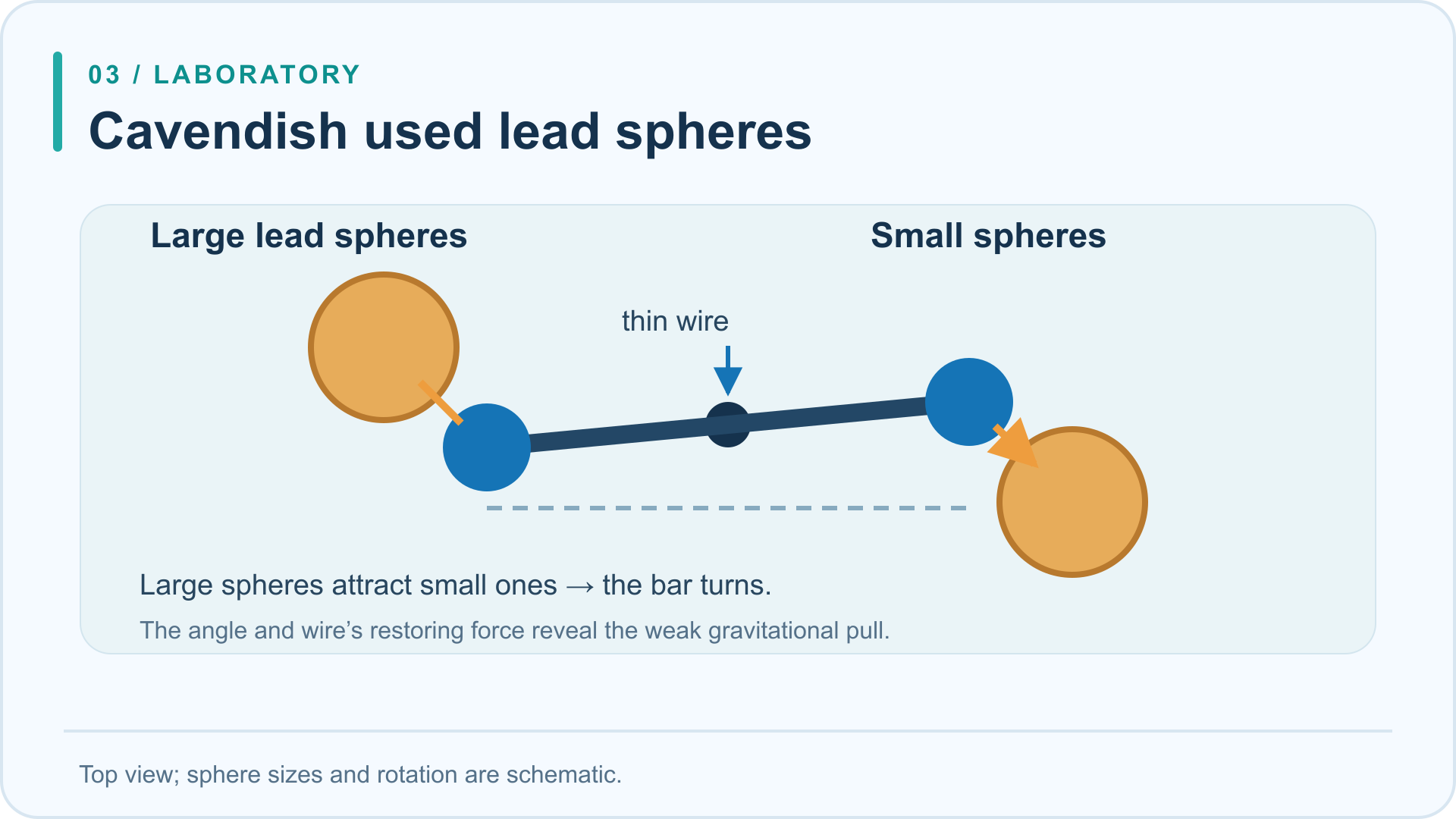
Two decades later, Henry Cavendish set up a more accurate experiment in Clapham, south of London. The idea of the torsion balance belonged to John Michell. Cavendish hung a lightweight bar with small lead balls on a thin thread and brought large lead balls to them. Their weak attraction slightly turned the bar and twisted the thread. By the rotation, vibrations and properties of the thread, it was possible to calculate the force of attraction.
Top view of a Cavendish torsion balance: large lead balls attracting small balls on a bar suspended by a thin thread
Scheme 3. Laboratory “mountain” - large lead balls. Open larger →
In a 1798 paper, Cavendish reported the Earth's density to be about 5.48 times that of water—substantially closer to the modern value. His experiment is often called "the first weighing of the Earth" because it is famous and much more accurate. It is historically important to distinguish this from the earlier assessment of Maskelyne and Hutton. Cavendish sought to determine preciselyEarth density; the now familiar description of his experiment as a measurement of the gravitational constant appeared later.
Where does the size of the Earth come from?
Without the size of the planet, density cannot be converted into mass: its volume is needed. The history of this dimension is much older. Eratosthenes also estimated the circumference of the Earth by the difference in solar shadows in two cities.The second article shows how the radius was obtained from this geometry →
Sources and clarifications
- Royal Society: the history of the Schiehallion experiment and Hutton's calculations.
- Charles Hutton, publication of calculations, 1778.
- Royal Society Archives: Cavendish manuscript, 1798.
- American Physical Society: structure and result of the Cavendish experiment.
- Max Planck Institute for the History of Science: Cavendish Studies at Clapham.
- NASA: modern mass, radius and average density of the Earth.