
How the Earth was measured · part 2 of 2. To estimate the radius of the planet, Eratosthenes did not need to go around it. It was enough to find out the distance between the two cities and compare the height of the Sun above them. First he obtained the circumference of the earth; The radius follows from it according to the school formula.
Who, where and when
Eratosthenes was active in Alexandria in Egypt around the middle of the 3rd century BC; a date often given is around 240 BC. The other city in his reasoning was Syene - present-day Aswan, south of Alexandria. This is the earliest known measurement of the size of the Earth for which an explanation of the geometric idea has been preserved. Eratosthenes’ own work has not reached us: the course of the experiment was retold by the much later author Cleomedes. Therefore, the details of the instruments and the method for determining the distance cannot be considered reliably established.
Two places in Egypt at midday of the summer solstice: in Alexandria a vertical object casts a shadow, in Syene the Sun is almost at its zenith
Scheme 1. The sun's rays are almost parallel, but the local vertical in the two cities is directed differently. Open larger →
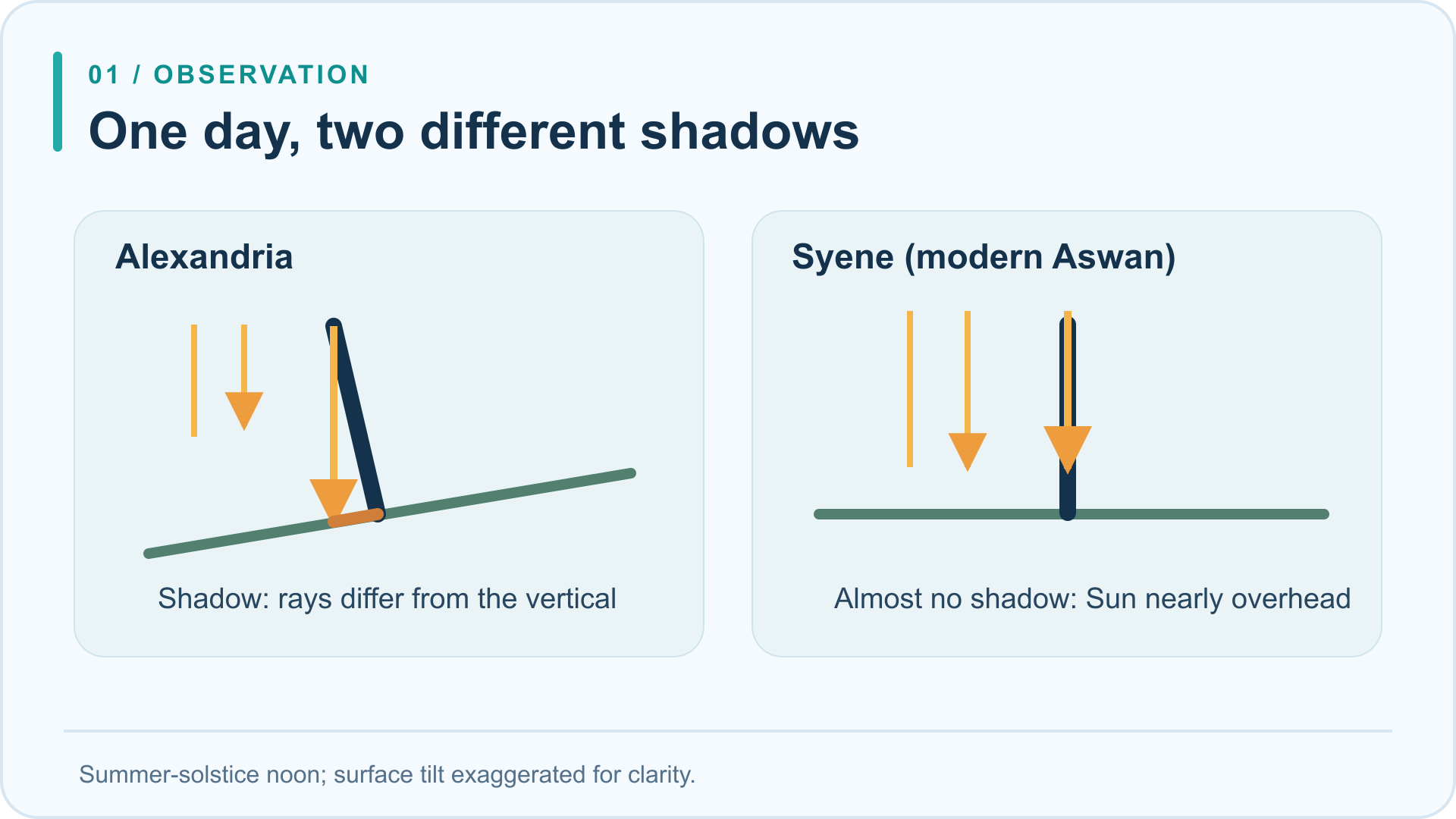
From shadow to angle
At noon on the summer solstice in Syene, the Sun was almost overhead: a vertical object cast almost no shadow. In Alexandria at this time the shadow remained. If we consider the sun's rays to be parallel, the difference in the local vertical directions is equal to the angle between the cities when viewed from the center of the spherical Earth.
According to the story that has reached us, this angle wasone fiftieth of a full circle. In modern degrees, this is 360° / 50 = 7.2°. Degrees here are a convenient translation for the reader: Eratosthenes expressed the result as a fraction of a circle.
Diagram of the Earth: the Alexandria-Syene arc is one fiftieth of a circle; 5000 stades multiplied by 50, the radius is obtained by dividing the circle by 2 pi
Scheme 2. The angle in the figure is enlarged; It is the proportion, not the scale of the drawing, that is important. Open larger →
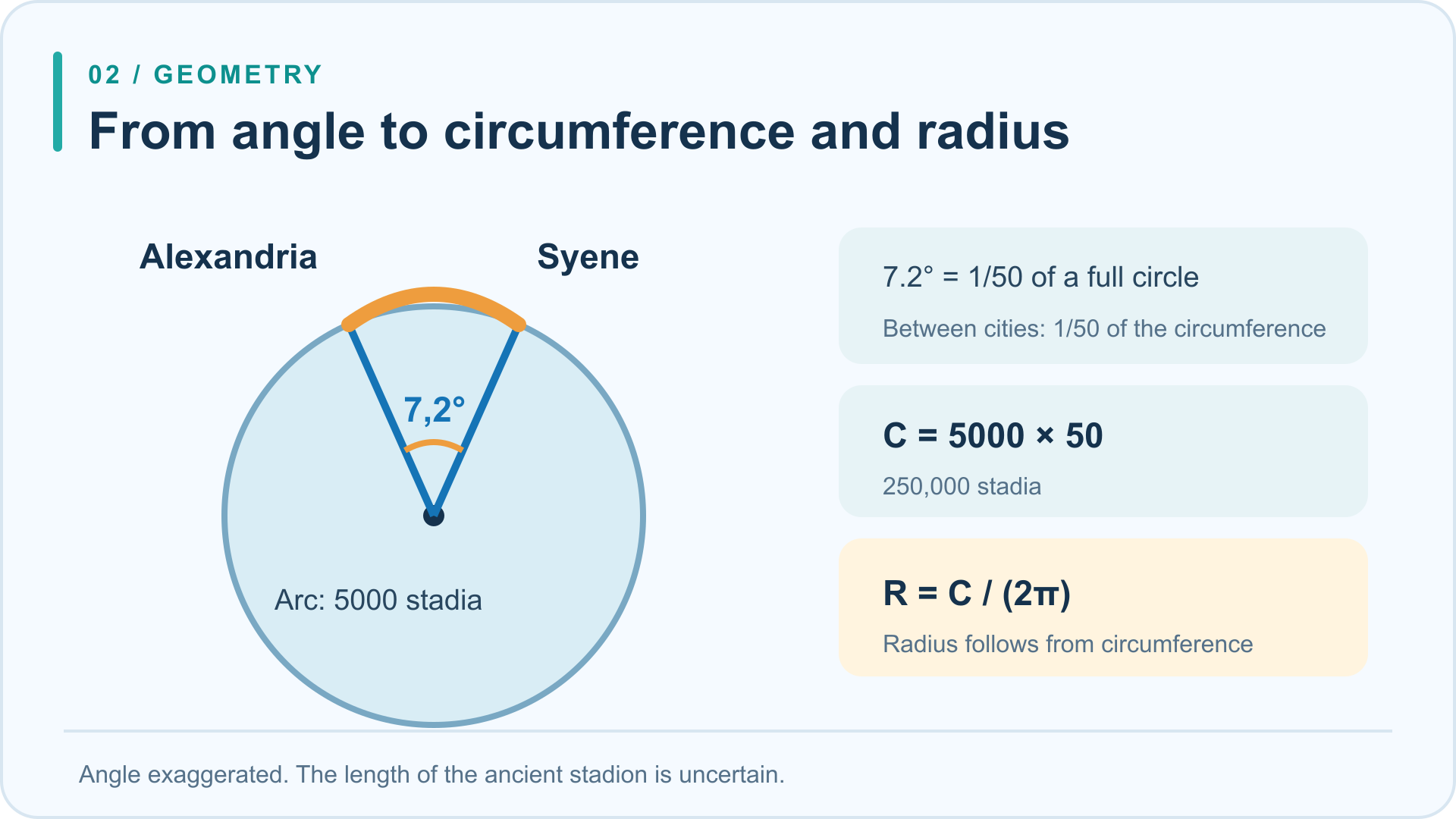
How the whole Earth came out of one arc
The distance from Alexandria to Syene in ancient calculations was taken to be5000 stadia. If this arc is 1/50 of a full circle, then the circumference of the Earth is 5000 × 50 =250,000 stadia. In other ancient reports the value of 252,000 stadia is also found; researchers debate when and why it appeared.
For a circle, circumferenceC = 2πR. So the radiusR = C / (2π). Thus the historical measurement of the circle becomes an estimate of the radius. For visual purposesmodern estimates: if we take the distance between cities as approximately 800 kilometers, we get a circumference of about 40,000 kilometers and a radius of about 6,366 kilometers. This is an illustration of the method and not an exact translation of ancient stadia into kilometers.
Where the estimate was approximate
Eratosthenes proceeded from the sphericity of the Earth, the almost parallel rays of the sun, and the assumption that cities lie approximately on the same meridian. The latter is not entirely true; Syene is also not located exactly on the tropic. It is not fully known what length of the stadion was used in the original calculation. Therefore, the popular phrase “Eratosthenes was wrong by only a fraction of a percent” cannot be confidently confirmed by simply converting 250,000 stadia to kilometers.
The geometric idea itself remains clear and strong: by measuring the angle and length of one small area, you can find out the size of the entire planet. Today the average volumetric radius of the Earth is estimated at6371 kilometers. At the same time, the Earth is slightly flattened: the radius at the equator and at the poles differs.
Why was radius needed later?
Knowing the radius, you can calculate the volume of the Earth. And the volume together with the average density allows us to estimate the mass.The first article describes how the attraction of a mountain and lead balls helped to find this density →