
Science and culture · six films, six scientific ideas. Movies have a way of making us worry about a person who flies around the Earth, gets lost on Mars, or is several decades late getting home. But sometimes the most interesting character in the frame is the law of nature. He doesn’t say any lines, but he decides whether the heroes can stand on the floor, breathe and wait for an answer.
Let's look at six space films: from a completely terrestrial problem with air to the curved light of a black hole. There are details of individual scenes here, but we are not retelling the endings. The illustrations are our explanatory diagrams, not stills from films; Their sizes and distances are schematic.
1. Interstellar (2014): why the disk bent around a black hole
Gargantua has a strange appearance: a luminous stripe crosses a dark silhouette, and arcs are visible above and below it. It seems that the artists put several hoops of fire on the black hole. However, this image does not require multiple disks.
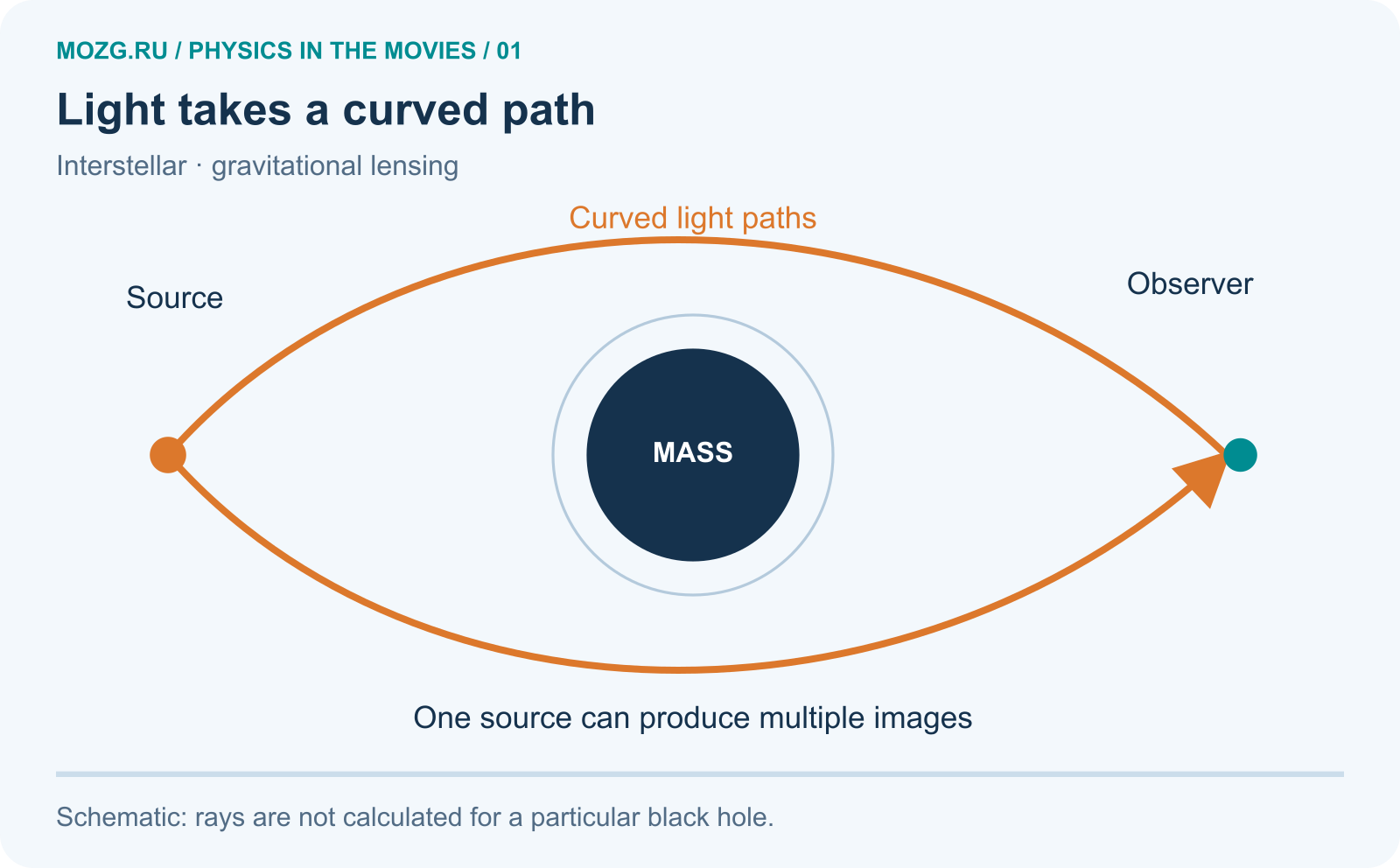
Hot matter revolves around a black hole in an accretion disk. Strong gravity bends the paths of light, and the observer can see parts of the far side of the disk that would be hidden if light propagated in a straight line. It turns outgravitational lens: the visible appearance of an object changes on the way from it to us.
For the film, the visual effects team and physicist Kip Thorne developed a program to calculate the propagation of beams of light in the space-time of a spinning black hole. The work became a scientific publication. This is not a photograph of a real object: the choice of parameters and artistic presentation still influence the result. But the unusual geometry has a physical basis.Article by the creators of the model →
Two conventional paths of light go around a massive object and come to the observer: gravity changes the apparent position of the source
Scheme of the lensing principle. This is not a calculation of Gargantua's rays or an image of its disk. Open larger →
Another idea of the film - the different passage of time - also relates to the general theory of relativity. The clocks being compared may accumulate different times depending on movement and gravitational conditions. Each observer experiences their own clock as running normally. However, the specific extreme conditions of the plot cannot be transferred to any planet near any black hole.Kip Thorne on the film's scientific themes →
2. “The Martian” (2015): the wind has speed, but it needs density
At the beginning of the film, the storm looks as if Mars has decided to immediately evict the expedition. Dust, poor visibility and danger to equipment are quite Martian. But the ability of the wind to push heavy objects is shown with great dramatic reserve.
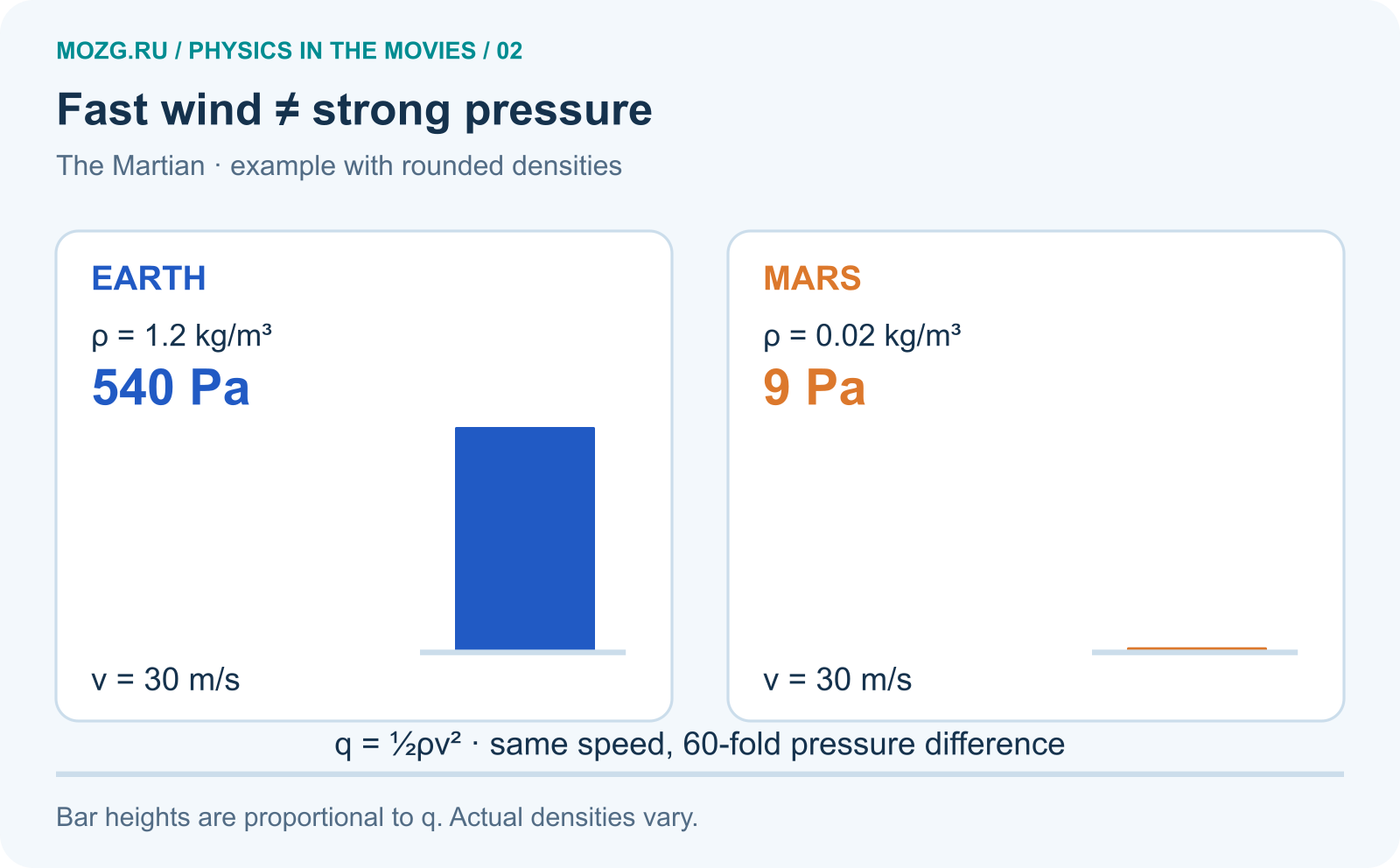
The flow action is described in a simplified waydynamic pressure q = ½ρv², where ρ is the gas density, v is its speed. To obtain force, you also need to consider the area and shape of the object. Martian air is much thinner than Earth's: the same wind speed does not mean the same pressure.
For educational assessment, let’s take a speed of 30 m/s and a density of 1.2 kg/m³ for Earth and 0.02 kg/m³ for Mars. We'll get about540 Pa vs 9 Pa- a difference of 60 times. This is a calculation with selected rounded densities, not a weather report from a specific scene: actual values depend on temperature, altitude and weather.
At the same speed of 30 meters per second, the calculation gives 540 pascals of dynamic pressure on Earth and 9 on Mars for the indicated densities
The pressure is compared at the same speed and explicitly specified densities. Open larger →
But it’s too early to calm down. Dust blocks sunlight, settles on panels and interferes with mechanisms. A real Martian storm can threaten energy reserves even if it doesn't knock out an astronaut.NASA sorts out the truth and fiction of Martian storms →
3. 2001: A Space Odyssey (1968): A floor made by rotation
People in space don't have to float between walls all the time. In A Space Odyssey, the rotating station offers a seemingly simple solution: make the outer wall become the floor. This kind of floor can really put pressure on your soles.
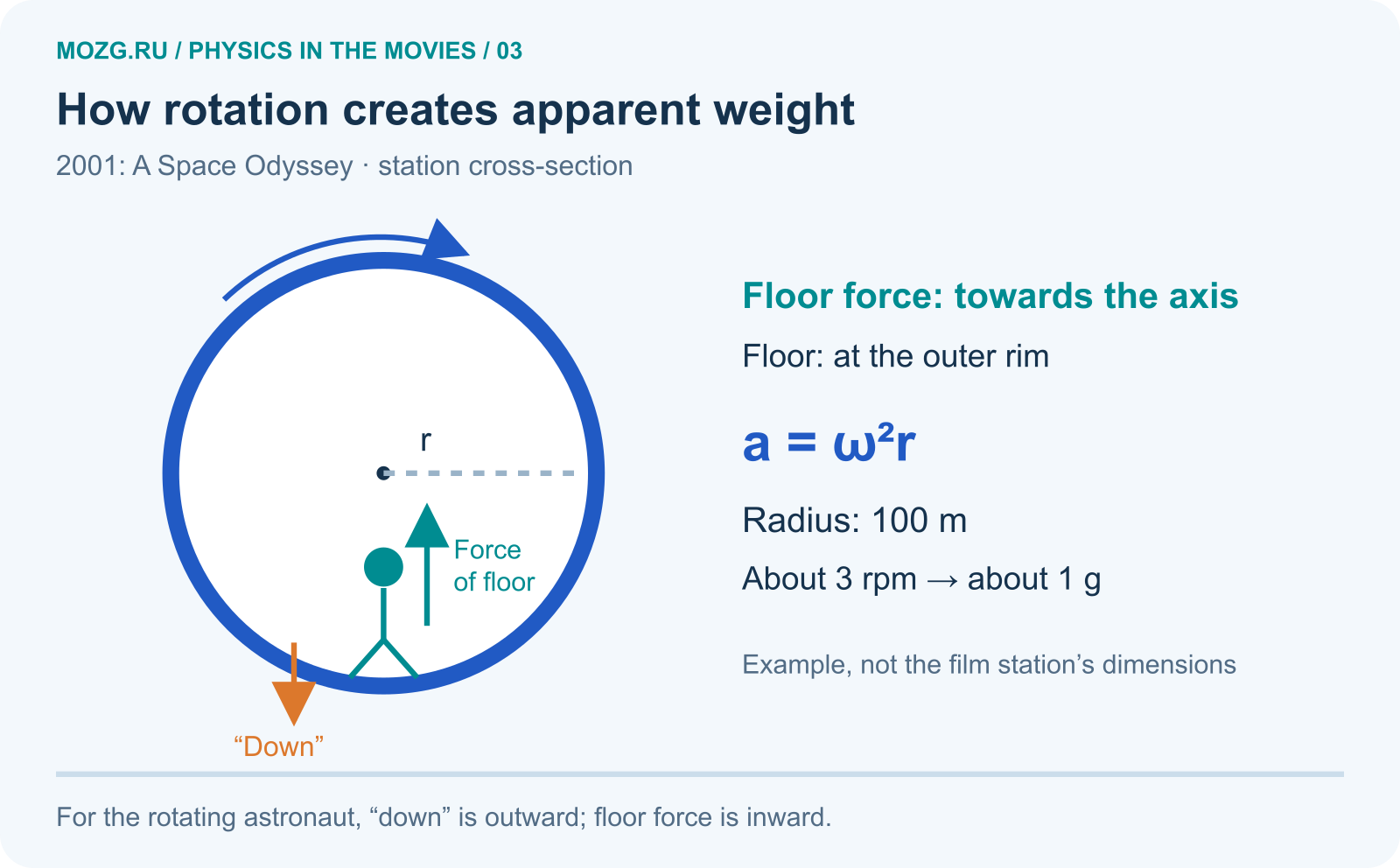
A person who rotates with the station needs centripetal acceleration. It is provided by support: the floor pushes the personto the axis of rotation. In the station's own frame of reference, this is described by a centrifugal force directed outward. The usual feeling of weight appears due to contact with the floor; they are not placing a new massive planet under the station.
The connection is simple:a = ω²r. For an invented station with a radius of 100 meters, the earth's acceleration at the rim would require approximately3 rpm. This is our example, not a measurement of the film's set. If we reduce the radius, we will have to rotate faster, and the difference in conditions at the head and legs will become more noticeable.
In a cross-section of the rotating station, a person stands with his feet at the outer rim; the force of the floor is directed towards the center, the conditional bottom is directed outwards
The sensation of weight and the direction of the support force are two different things: the force of the floor is directed towards the center. Open larger →
Engineering challenges remain: design, docking, rotation tolerance, unusual deflections of moving objects due to the Coriolis effect. Therefore, the correct physical idea does not yet mean a ready-made comfortable hotel.NASA: Rotating Frames; conversation between specialists about artificial gravity →
4. “Gravity” (2013): weightlessness - when the entire room falls
The heroes float next to the Earth, and it’s easy for the viewer to decide: perhaps the attraction here is no longer sufficient. The title of the film suggests otherwise. Earth's gravity is what keeps the orbital vehicle on its trajectory.
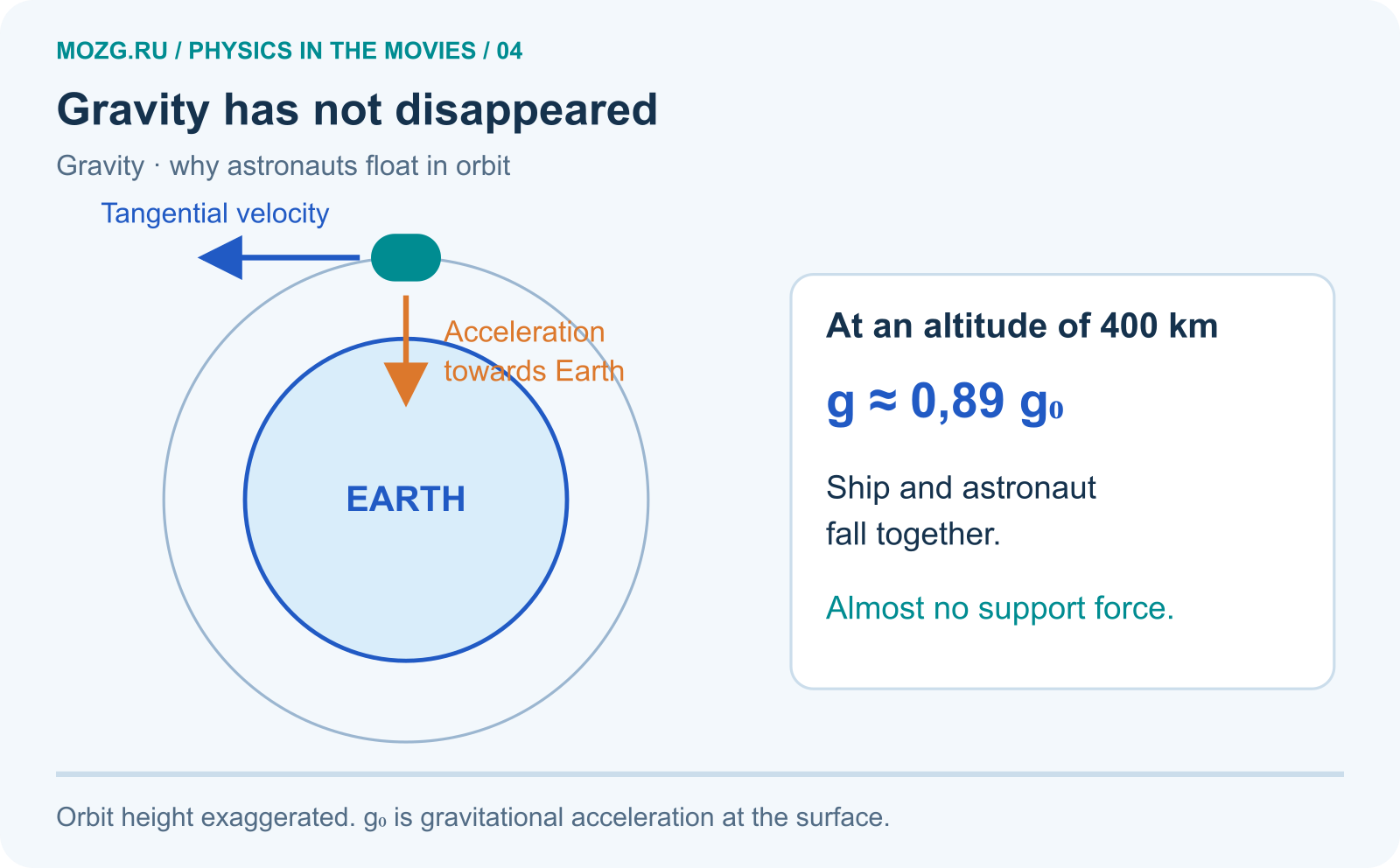
At an altitude of about 400 kilometers, the acceleration due to gravity is approximately89% of the surface value. The estimate is obtained from the ratio [R / (R + h)]²: for R ≈ 6371 km and h = 400 km it comes out to 0.885. Rising to this height is not at all the same as turning off the Earth.
The secret of weightlessness is free fall together. The ship and the man inside are constantly falling, but the high lateral speed allows them to go around the planet. The floor does not support a person as much as it would in a stationary room. Therefore, the body exerts almost no pressure on the support, although gravity acts.
The spacecraft moves in orbit: the speed is directed tangentially, the acceleration of gravity is directed towards the center of the Earth
Velocity and acceleration have different directions. The orbit is a continuous free fall around the Earth. Open larger →
This idea explains the people's swimming, but does not in itself support the rest of the film's maneuvers. Rendezvous in orbit means matching position and speed, rather than simply heading towards a visible point. One conclusion is important for our analysis:no weight does not equal no gravity. NASA explains microgravity →
5. Apollo 13 (1995): there is oxygen, but breathing is still dangerous
One of the most intense engineering scenes is done without a futuristic machine: an inappropriate filter must be adjusted. After the accident, the lunar module became a refuge for three astronauts, and the problem of removing carbon dioxide arose.
We exhale CO₂. In a closed volume, it is not enough to simply have a supply of oxygen: the composition of the air must be maintained by removing respiration products. The mission used lithium hydroxide absorbers. The square cartridges of the command module did not fit into the round holes of the lunar module system. Terrestrial specialists developed an adapter from materials available on board, and the crew assembled it according to the instructions.
Air with carbon dioxide passes through the adapter and absorber; There is less carbon dioxide at the output, the filter does not create oxygen
The principle of operation is shown, and not an assembly drawing of a historical adapter. Open larger →

This is where chemistry and engineering meet: the absorber binds carbon dioxide, and the adapter forces air through the desired cartridge. The filter itselfdoes not convert CO₂ into oxygen. It has a limited capacity, and without a properly organized flow, the useful substance inside the box does not save the situation.
The scene is based on a documented problem from a real mission in April 1970. This is a good example of science that doesn't just work in the lab: sometimes the crucial question is "how do you put these two things together?"NASA: mission progress and the problem of incompatible absorbers →
6. Contact (1997): Interstellar correspondence requires patience
Ellie Arroway picks up a radio signal from the direction of Vega. If we mentally replace the cryptic message with a simple “hello”, an everyday question arises: when can we expect a response to our response?
Radio waves are electromagnetic radiation. In a vacuum, they travel at the same speed as visible light - approximately 300 thousand kilometers per second. A larger antenna helps receive a weak signal, but does not force it to arrive sooner.NASA: electromagnetic wave speed →
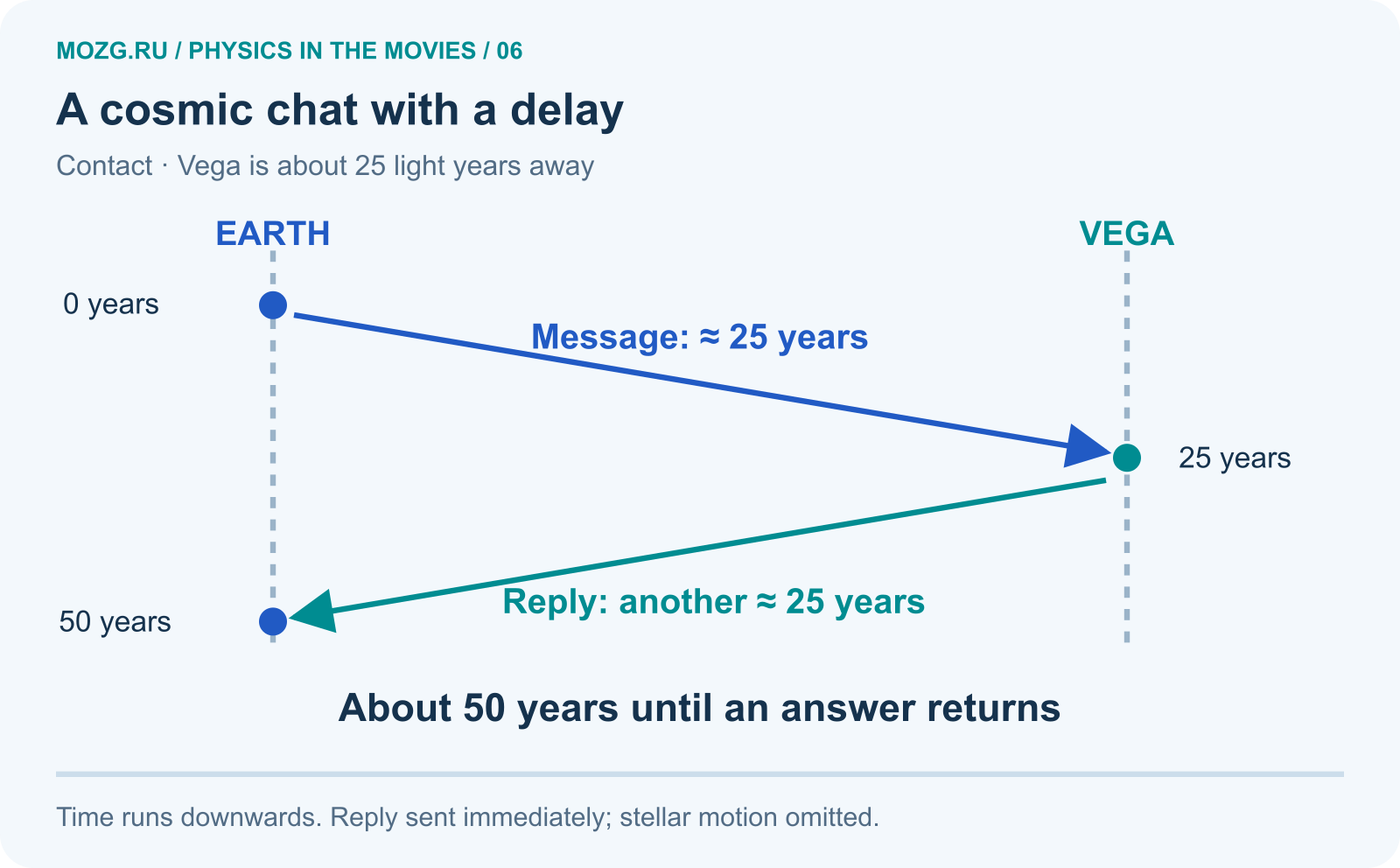
About Vega25 light years. A light year is the distance that light travels in a year. This means that our signal would have gone there for about a quarter of a century. If they answer there immediately, the return journey will take the same amount of time: about50 years from sending a question to receiving an answer. This is a simple estimate of the delay for recipients that are stationary relative to each other, and not a promise that the transmission will be detectable at all.NASA: distance to Vega →
A message from Earth to Vega takes about 25 years, an immediate response takes another 25; the total wait is about 50 years
Educational timeline. Response preparation time is not included. Open larger →
There is also a subtlety of film language: a radio signal is not a sound flying through the void. The receiver can convert the data into an audible representation. Real search requires signal processing and interference checking, not just one listening ear. The NRAO website contains an analysis of the film by SETI specialists.What “Contact” shows accurately and what it simplifies →
What to ask the next space movie
You don't have to watch a movie with a calculator. Three questions are enough:What creates the force, where does the energy go, and how long does the signal take? They help separate a spectacular technique from an interesting physical idea. And sometimes you discover that reality is more amazing than the scenery: you can fall and miss the Earth all the time, see the hidden side of the disk and receive an answer to a school letter after retirement.
If you want to continue:as Roemer noted that light is not instantaneous, how the earth was weighed andhow science got into rock songs.
Sources are listed alongside relevant explanations. Numerical examples and diagrams were prepared by the editors of Mozg.ru; they explain individual principles rather than confirm the scientific accuracy of entire films.